


 Fill out surveys
 Bulmaca
 Terms of Service
Methanol Market Business Status and Future Outlook Analysis 2032
Introduction
The Methanol Market refers to the global industry producing, distributing, and consuming methanol, a simple alcohol chemical (CH₃OH) derived from natural gas, coal, biomass, or captured carbon. It functions as a core industrial feedstock and an emerging energy and fuel solution. Methanol is used in manufacturing formaldehyde, acetic acid, methyl tert-butyl ether (MTBE), dimethyl ether (DME), olefins, solvents, adhesives, plastics, paints, and pharmaceuticals. It is gaining strong adoption as a marine fuel, clean-burning transport fuel, hydrogen carrier, and power-generation blendstock.
The global importance of methanol continues to expand due to its dual role in chemicals and sustainable energy. Countries with large-scale refining, petrochemical processing, and growing decarbonization policies are increasing methanol demand for both industrial applications and cleaner fuel alternatives. Methanol plays a significant role in lowering sulfur emissions, improving fuel combustion, enabling green hydrogen transport, and supporting carbon-neutral fuel ecosystems.
Learn how the Methanol Market is evolving—insights, trends, and opportunities await. Download report: https://www.databridgemarketresearch.com/reports/global-methanol-market
The Evolution
Methanol’s commercial development began in the early 20th century when it was primarily produced through wood distillation and referred to as “wood alcohol.” Traditional production was limited in scale and purity, making it unsuitable for mass chemical manufacturing. The first major milestone arrived in the 1920s when synthetic methanol production via catalytic conversion of syngas (using carbon monoxide and hydrogen) was industrialized. This advancement opened the door for high-purity methanol and large-scale commercialization.
A major innovation occurred in the 1960s when natural gas steam reforming became the dominant methanol production pathway, replacing biomass-based distillation methods. Natural gas offered higher hydrogen efficiency, lower emission intensity (compared to coal), improved economics, and greater scalability. During the 1980s–1990s period, methanol became widely commercial as a petrochemical feedstock, particularly for producing formaldehyde and MTBE, both of which experienced significant demand as industrial materials and gasoline additives.
Between 2000–2015, China rapidly expanded coal-to-methanol plants, driven by abundant domestic coal reserves. Since 2015, the industry has undergone strong technological shifts:
-
Methanol-to-Olefins (MTO) and Methanol-to-Propylene (MTP) technologies commercialized, reducing reliance on crude-oil-derived olefins.
-
Methanol’s adoption as an alternative clean fuel increased in marine shipping due to sulfur cap compliance.
-
Research accelerated in biomethanol and e-methanol (carbon-neutral methanol produced via CO₂ hydrogenation using renewable hydrogen).
Shifts in demand are now increasingly influenced by sustainability priorities, carbon compliance policies, hydrogen commercialization, large-scale LNG availability, petrochemical diversification, and evolving fuel standards. Methanol is no longer a chemical product alone; it is shaping infrastructure for future clean energy systems.
Market Trends
Several global patterns are driving the modern Methanol Market:
Emerging Consumer and Industry Trends
-
Marine fuel adoption is growing as methanol-powered vessels and dual-fuel engines increase, driven by cleaner combustion and regulatory compliance.
-
Flex-fuel blending in transportation using methanol-gasoline mixes is expanding, particularly in China, India, and pilot projects across Europe.
-
Green and blue methanol investments are increasing as companies diversify supply chains to include low-carbon feedstocks.
-
Demand for methanol derivatives used in packaging, coatings, synthetic resins, and adhesives continues to increase due to growth in automobiles, housing materials, industrial equipment, and consumer products.
-
Methanol as a hydrogen carrier is emerging because of its liquid stability, transport feasibility, and decomposition capability at the point of use.
Technology and Process Advancements
-
Carbon capture integrated methanol plants utilizing CO₂ hydrogenation are scaling beyond lab-level to commercial production.
-
Biomass gasification for bio-methanol production is gaining regional traction, including waste-to-methanol models.
-
Improved catalyst efficiency in MTO, MTP, and CO₂-to-methanol conversion is reducing energy intensity and process cost.
-
AI-enabled plant operations, predictive maintenance, supply forecasting, and emission analytics are becoming standard in new infrastructure.
Regional Adoption Patterns
-
Asia-Pacific: China dominates production with continuous expansions in coal-based and carbon-neutral methanol projects. India is rapidly scaling MTO and fuel blending agendas.
-
North America: Focus remains heavily on natural gas-based methanol with increasing blue methanol capacity (CCUS integrated).
-
Middle East & Africa: Major global export hub due to abundant feedstock from natural gas and cargo logistics advantage.
-
Europe: Growth centered on bio- and e-methanol, marine fuel, automotive fuel pilots, and regulatory sustainability support.
-
Latin America: Chile, Brazil, and Argentina are exploring renewable methanol production tied to biomass and hydrogen agendas.
Challenges
Although the Methanol Market continues expanding, several barriers affect growth stability:
Regulatory and Compliance Challenges
-
Methanol fuel adoption requires new safety frameworks, fuel handling rules, storage codes, and infrastructure compliance which differ across regions.
-
Strict environmental policies affect coal-based methanol production expansion, increasing the pressure to integrate CCUS or renewable hydrogen for sustainability viability.
Economic and Market Barriers
-
Methanol pricing fluctuates based on natural gas, LNG, and coal market volatility, impacting production cost stability.
-
Capital expenditure for bio- and e-methanol plants remains high, delaying mass commercialization.
Supply Chain and Logistics Challenges
-
Transportation and storage require corrosion-resistant and methanol-safe fuel-grade pipelines, tanks, coatings, and seals which must be upgraded in legacy facilities.
-
Methanol is toxic and highly flammable, requiring strict supply chain risk mitigation, specialized carrier training, and fuel-grade infrastructure.
Key Risks
-
Feedstock dependency risks from energy market instability.
-
Slow infrastructure transition for clean methanol fuel expansion.
-
Safety risks in storage, leakage, fuel handling, and port or industrial facility compliance.
-
Competition from alternative fuels such as hydrogen, ammonia, batteries, and ethanol in some segments, although methanol maintains advantages in liquid stability, density, cost, and scalability.
Market Scope
The Methanol Market is segmented across multiple industry layers:
Segmentation by Source Type
-
Natural Gas-Based Methanol
-
Coal-Based Methanol
-
Bio-Methanol (Biomass Gasification, Waste Gasification)
-
Blue Methanol (CCUS integrated natural gas methanol)
-
Green Methanol (Renewable hydrogen + CO₂ hydrogenation)
-
E-Methanol (Renewable power + carbon conversion process)
Segmentation by Application
-
Formaldehyde production
-
MTBE and gasoline blending
-
MTO/MTP (olefins and propylene production)
-
Acetic acid synthesis
-
Dimethyl ether (DME) production
-
Industrial solvents and chemical intermediates
-
Power generation and heavy industry fuel
-
Marine shipping fuel
Regional Scope
-
North America: United States, Canada, Mexico
-
Europe: Germany, UK, France, Italy, Spain, Nordics, Benelux, Rest of Europe
-
Asia-Pacific: China, India, Japan, South Korea, Indonesia, Malaysia, Australia, Rest of APAC
-
Latin America: Brazil, Chile, Argentina, Rest of LATAM
-
Middle East & Africa: GCC countries, South Africa, Rest of MEA
Segmentation by End-User Industries
-
Chemical manufacturing
-
Automotive and transport fuels
-
Marine shipping and port fuel infrastructure
-
Construction materials (adhesives, resins, paints)
-
Electronics and polymer manufacturing
-
Pharmaceuticals
-
Energy producers and fuel distributors
Market Size and Factors Driving Growth
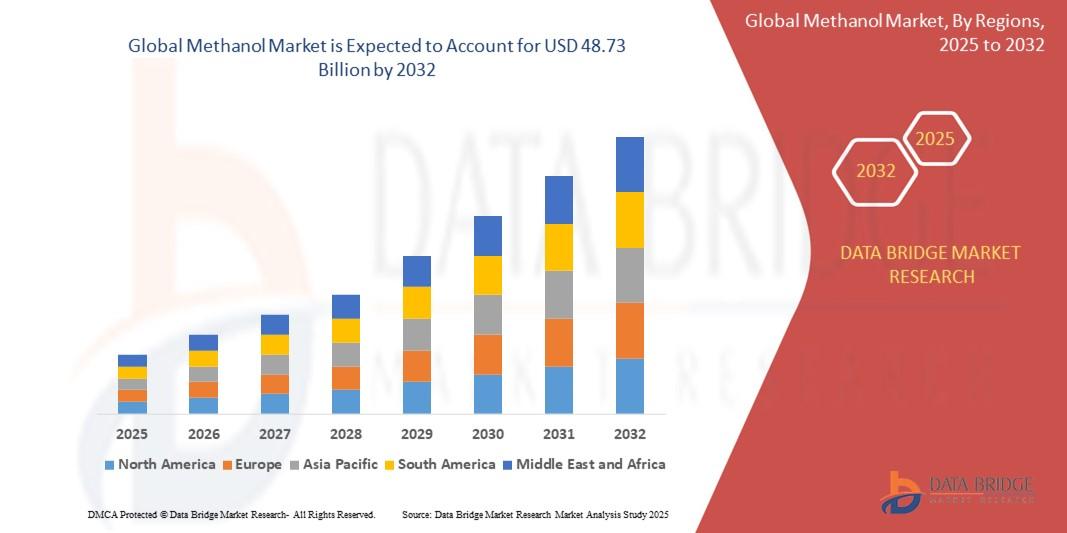
- The methanol market size was valued at USD 33.49 billion in 2024 and is expected to reach USD 48.73 billion by 2032, at a CAGR of 4.8% during the forecast period
Growth Drivers
-
Technology: MTO/MTP commercialization, improved catalysts, industrial automation, CCUS integration
-
Population and Industrialization: growing infrastructure demand increases methanol-derived polymers, resins, and adhesives consumption
-
Sustainability Policies: IMO sulfur caps, carbon-neutral fuel incentives, renewable hydrogen infrastructure, emission reduction mandates
-
Feedstock Availability: expanded LNG production and competitive natural gas supply for North America and GCC exporters
-
Energy Transition Opportunity: methanol as a hydrogen carrier supporting fuel portability
-
Opportunities in emerging regions: India, Southeast Asia, Africa waste-to-methanol, Europe e-methanol funding programs, Latin American biomass-linked hydrogen and biofuel ecosystems
Regional Growth Outlook
-
Asia-Pacific leads in valuation and volume due to China and India's production and derivative expansion.
-
GCC countries support strong global export logistics, ensuring market liquidity.
-
Europe leads in clean, bio- and e-methanol commercialization supporting future fuel networks.
FAQ
1. What is the current size of the global Spirits Market?
2. How is green methanol expected to change the chemical sector?
3. Which country leads the methanol fuel blending network?
4. What are the main applications of methanol derivatives?
5. How are coal-to-methanol producers adapting to emission policies?
6. What factors affect methanol price volatility?
7. Why is methanol considered a hydrogen carrier option?
8. Which regions will see the fastest MTO/MTP expansion?
9. What safety concerns surround methanol storage and transport?
10. How is methanol competing with ammonia and hydrogen in marine fuel?
11. What infrastructure upgrades are needed for fuel-grade methanol distribution?
12. How will carbon capture accelerate blue methanol adoption?
13. What opportunities exist for biomass and waste-based methanol production?
Browse More Reports:
Global Professional Footwear Market
Global Semiconductor Memory Market
Global Single Use Medical Devices Reprocessing Market
Global Stainless Steel Lunchbox Market
Global Textured Vegetable Protein Market
Global Vascular Imaging Market
Global Veterinary Reference Laboratory Market
Global Chitin and Chitin Derivatives Market
Global Duchenne Muscular Dystrophy Treatment Market
Global Amyotrophic Lateral Sclerosis Treatment Market
Global Mobile Photo Printer Market
Global Tax Tech Market
Middle East and Africa Point-Of-Care-Testing (POCT) Market
Middle East and Africa Very Small Aperture Terminal (VSAT) Market
Asia-Pacific Used Car Market
About Data Bridge Market Research:
An absolute way to forecast what the future holds is to comprehend the trend today!
Data Bridge Market Research set forth itself as an unconventional and neoteric market research and consulting firm with an unparalleled level of resilience and integrated approaches. We are determined to unearth the best market opportunities and foster efficient information for your business to thrive in the market. Data Bridge endeavors to provide appropriate solutions to the complex business challenges and initiates an effortless decision-making process. Data Bridge is an aftermath of sheer wisdom and experience which was formulated and framed in the year 2015 in Pune.
Contact Us:
Data Bridge Market Research
US: +1 614 591 3140
UK: +44 845 154 9652
APAC : +653 1251 975
Email:- corporatesales@databridgemarketresearch.com
"

 English
 Arabic
 French
 Spanish
 Portuguese
 Deutsch
 Turkish
 Dutch
Dutch
 Italiano
 Russian
 Romaian
 Greek
Greek