


 Fill out surveys
 Bulmaca
 Terms of Service
Sustainable Sportswear Market Business Status and Future Outlook Analysis 2032
Introduction
The Sustainable Sportswear Market consists of athletic and performance apparel designed, manufactured, and distributed using environmentally responsible materials, low-impact production systems, energy-efficient processing, recycled fibers, bio-based textiles, waterless dyeing technologies, closed-loop manufacturing, and ethical labor standards. Sustainable sportswear includes activewear, outdoor sports apparel, gym clothing, running apparel, yoga wear, athleisure performance outfits, footwear-linked sportswear, and accessories built with sustainability certification models.
The expansion of global fitness participation, environmental awareness, government-supported circular economy roadmaps, corporate sustainability compliance, investor support for textile decarbonization, consumer preference for durable eco-products, growth in high-performance recycled fibers, and increasing retail transparency standards have made sustainable sportswear one of the most strategically valued verticals in the sports textile industry.
Learn how the Sustainable Sportswear Market is evolving—insights, trends, and opportunities await. Download report: https://www.databridgemarketresearch.com/reports/global-sustainable-sportswear-market
The Evolution
Historical Development
Sportswear manufacturing was historically based on conventional cotton, polyester, nylon, PVC-coated sports jackets, chemically intensive dyeing, petroleum-based elastane, foam-based padding, synthetic footwear-linked sports apparel, silicone-coated sports accessories, and fluorocarbon-based finishes (PFCs, PFOAs, PFAS coatings). Sustainability adoption was minimal before 2010. The earliest sustainable sports textile checkpoints were created by independent textile research groups experimenting with organic cotton sports jerseys, recycled PET fleece, recycled ocean plastic bags converted to yarn, biodegradable sport finishes, compostable zip components, natural rubber sports silicone alternatives, and non-toxic sweat-absorbing chemistry.
Shifts in Demand and Technology
-
Shift from petroleum-based polyester and nylon to rPET and recycled nylon blends
-
Decline of fluorocarbon finishes (PFAS, PFOA, PFC) in favor of PFC-free water repellents
-
Movement from fast-fashion athleisure to durable circular sports apparel lines
-
Integration of waterless dyeing, plant-based elastane alternatives, microplastic-safe yarn processing, closed-loop machinery, solvent recovery, and AI-optimized sustainability traceability in high-capacity sports textile plants
Sustainable sportswear moved from a niche category to a defined global market sub-sector backed by government roadmaps, major athletic brands, retail chains, new-age eco-marketplaces, global sports leagues, sustainable uniform manufacturing orders, textile recycling companies, polymer innovators, carbon-based textile pilots, plant-based chemical producers, waterless dyeing machinery suppliers, AI-enabled sustainability software providers, logistics partners, sustainable footwear-apparel integration firms, athletic distributors, and sustainability certification bodies.
Market Trends
Emerging Consumer Trends
-
Preference for long-lasting, washable, non-toxic, breathability-balanced, odor-free, lightweight, high-recovery stretch, PFC-free, microplastic-safe, sweat-wicking, moisture-balanced, anti-bacterial natural chemistry, recycled packaging, sustainable footwear-linked sports outfits
-
Demand for transparent sustainability labeling (OEKO-TEX®, GRS, Bluesign®, Fair Trade, BCI, Cradle-to-Cradle, organic and recycled content claims, carbon footprint tags)
-
Growth of eco-athleisure with sustainable sports leggings, hoodies, T-shirts, shoes, socks, uniforms, and jackets
-
Increasing interest in plastic-neutral sports apparel, waste-to-textile sport yarn, ocean-plastic sport uniforms, gym apparel recycling programs, and biodegradable sport coatings
Technology Adoption
-
Waterless dyeing (CO₂ dyeing, foam dyeing, pigment color spray, spin-dye) reducing water use by up to 95%
-
Closed-loop knitting and weaving systems minimizing waste generation
-
Bio-based performance fibers (hemp-cotton sport blends, lyocell sport yarn, PLA sport fibers, algae-polyester blends, bio-spandex alternatives, natural rubber sport coatings)
-
Recycled high-performance yarn production (rPET, recycled nylon, recycled cotton blends)
-
AI-driven supply chain traceability, carbon reporting, demand forecasting, sustainable logistics routing, solvent recovery, machine-level optimization, emission analytics, lifecycle impact tracking, sustainability scoring engines, eco-retail dashboards
Challenges
Industry Challenges
-
Regulatory complexity due to different national textile recycling rules, chemical restrictions, footwear-apparel compliance definitions, sustainability labeling standards, recycled content guidelines, PFAS-free policy enforcement, carbon reporting policies, ESG-linked retail compliance rules
-
Economic barriers from high production costs of bio-based elastane and fully circular sportswear authentication lines
-
Supply chain pressure from limited regional recycling textile feedstock availability for premium sport yarn, logistics cost linked to certified raw materials
Barriers to Growth
-
Infrastructure cost for waterless dyeing equipment, closed-loop knitting machinery, solvent recovery systems, sustainability traceability software integration
-
Safety requirements for some bio-polymers in elite performance sportswear that must balance stretch recovery, longevity, comfort, sweat-wicking, heat dispersion, wash durability, moisture balance
-
Market competition from traditional petroleum-based sportswear suppliers that remain cheaper to manufacture
Market Risks
-
Pricing volatility in natural gas, recycled PET, recycled nylon, biomass-linked polymers, carbon-feedstock recovery, sustainable logistics costing
-
Slow legacy infrastructure transition toward closed-loop sport machinery pipelines
-
Chemical safety compliance risks where production differs by country, requiring localized regulatory-grade manufacturing templates
Market Scope
Segmentation by Product Type
-
Recycled Polyester Sportswear (rPET apparel, ocean plastic sport uniforms, recycled fleece, recycled socks, jackets, leggings)
-
Recycled Nylon Sportswear (performance leggings, jackets, gym wear, yoga outfits, footwear-linked apparel mixes)
-
Organic Cotton Sportswear (sport uniforms, premium athleisure tees, socks)
-
Bio-Based Sportswear (hemp-cotton sport blends, lyocell sport yarn, PLA sport fibers, algae-polyester blends, bio-spandex alternatives, natural rubber sport coatings)
-
PFC-Free Performance Sportswear (non-fluorinated water-repellent jackets, moisture-balanced coatings)
Segmentation by Application
-
Outdoor Sports Apparel: hiking, trekking, skiing, adventure sport outfits
-
Fitness and Gym Wear: yoga wear, pilates, cross-fit gear, sports leggings, hoodies, socks, sport tees
-
Running and Cycling Apparel: breathable shorts, sweat-wicking tops, footwear-linked outfits
-
Sports League Uniforms: teams shifting to plastic-neutral or recycled sport uniforms
-
Footwear-Integrated Sustainable Apparel Ecosystems: shoe-apparel recycling take-back networks
Segmentation by Technology
-
Waterless Dyeing (CO₂ dyeing, foam dyeing, pigment color spray, spin dye)
-
Closed-Loop Knitting and Weaving Machinery
-
Biomass to Yarn Conversion
-
Solvent Recovery and Eco-Finishing Systems
-
AI-Enabled Sustainability Traceability Platforms
Regional Analysis
-
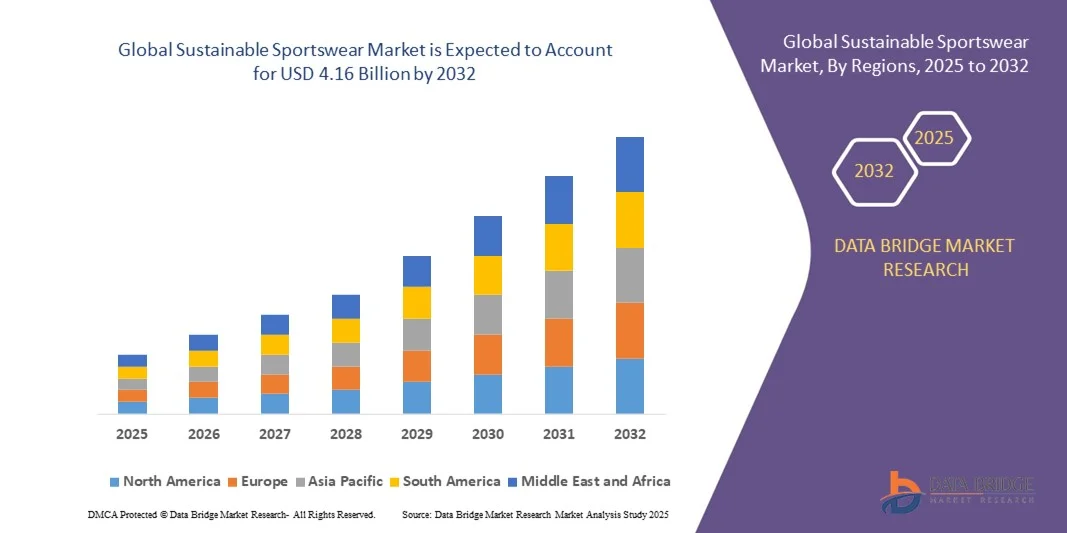
North America (United States, Canada, Mexico)
-
Europe (Germany, UK, France, Italy, Spain, Nordics, Benelux, Rest of Europe)
-
Asia-Pacific (China, India, Japan, South Korea, Southeast Asia, Australia, Rest of APAC)
-
Latin America (Brazil, Argentina, Chile, Rest of LATAM)
-
Middle East & Africa (GCC, South Africa, Rest of MEA)
End-User Industries
-
Sports leagues, fitness centers, adventure sports firms, gym apparel brands, footwear-apparel integration companies, sustainable fashion retailers, high-performance sportswear manufacturers, procurement partners for team uniforms, recycled sports accessory suppliers, athletic distributors, digital sports marketplaces, D2C eco-sports brands.
Market Size and Factors Driving Growth
- The global sustainable sportswear market size was valued at USD 2.77 billion in 2024 and is expected to reach USD 4.16 billion by 2032, at a CAGR of 5.2% during the forecast period
Major Growth Drivers
-
Technology: expansion of rPET, recycled nylon, PLA sport yarn polymers, algae-poly blends, bio-spandex alternatives, closed-loop sport machinery, solvent-recovery finishing systems, and AI-driven product traceability.
-
Population: increased global participation in fitness, gym memberships, marathon culture, cycling networks, adventure sport tourism.
-
Sustainability: decline of fluorocarbon sport coatings, enforcement of PFAS-free policies, growth of plastic-neutral sport uniforms, water-saving compliance verification.
-
Policies: textile recycling rules in Europe, sustainability procurement pilots for major sports leagues, retail sustainability labeling enforcement in North America, circular fashion incentives in Asia-Pacific, waste-to-yarn export support in emerging biomass supply regions, carbon-neutral textile pilots.
Growth Opportunities in Emerging Regions
-
Asia-Pacific: largest recycling feedstock base, MTO polymer adoption for sport textiles, government-backed circular fashion roadmaps, high production capacity scaling.
-
Latin America: organic cotton sport uniforms, sugarcane-spandex textile pilots in Brazil, biomass-to-yarn feedstock availability.
-
Middle East & Africa: sports league sustainable uniform pilots, GCC retail sustainability enforcement expansion.
FAQ (Without Answers)
1. What is the current size of the global Spirits Market?
2. How fast is the Sustainable Sportswear Market growing?
3. Which materials dominate sustainable sportswear production?
4. What are the main technology platforms supporting sustainable sportswear traceability?
5. Which region leads sustainable sportswear regulation compliance?
6. What barriers affect the pricing stability of sustainable sports fibers?
7. How is waterless dyeing influencing sports apparel manufacturing?
8. Why are sports leagues investing in sustainable uniforms?
9. What infrastructure upgrades are needed for closed-loop sustainable sportswear production?
10. How do safety concerns impact bio-based elastane adoption in high-performance sportswear?
11. What is the role of AI in sustainable sportswear supply chain analytics?
12. How is sustainable sportswear competing with conventional petroleum-based sports textiles?
13. Which end-user industries are expanding sustainable sportswear procurement?
14. What risks surround regional sustainability certification inconsistency?
15. How will biodegradable coatings expand sustainable sportswear adoption?
16. What opportunities exist for biomass-linked sports fiber scaling?
Browse More Reports:
North America Used Car Market
North America Traumatic Brain Injury Treatment Market
Middle East and Africa Telecom Managed Services Market
Asia-Pacific Telecom Managed Services Market
Vietnam Talc Market
Europe Sports Analytics Market
North America Smoking Cessation and Nicotine De-Addictions Market
Asia-Pacific Smart Medical Devices Market
Europe Smart Medical Devices Market
Korea Silicon Anode Material Battery Market
Asia-Pacific Satellite Transponder Market
Middle East and Africa Rotomolding Products Market
LATAM RFID Tags Market
Asia-Pacific Radio-Frequency Identification Technology (RFID) Market
North America Revenue Cycle Management (RCM) Market
About Data Bridge Market Research:
An absolute way to forecast what the future holds is to comprehend the trend today!
Data Bridge Market Research set forth itself as an unconventional and neoteric market research and consulting firm with an unparalleled level of resilience and integrated approaches. We are determined to unearth the best market opportunities and foster efficient information for your business to thrive in the market. Data Bridge endeavors to provide appropriate solutions to the complex business challenges and initiates an effortless decision-making process. Data Bridge is an aftermath of sheer wisdom and experience which was formulated and framed in the year 2015 in Pune.
Contact Us:
Data Bridge Market Research
US: +1 614 591 3140
UK: +44 845 154 9652
APAC : +653 1251 975
Email:- corporatesales@databridgemarketresearch.com

 English
 Arabic
 French
 Spanish
 Portuguese
 Deutsch
 Turkish
 Dutch
Dutch
 Russian
 Romaian
 Portuguese (Brazil)
 Greek
Greek