


 Fill out surveys
 Bulmaca
 Terms of Service
Data Center Construction Market Business Status and Future Outlook Analysis 2032
Introduction
Data Center Construction covers facility design, site engineering, electrical deployment, cooling infrastructure, server floor development, cabling, security systems, fire protection, and long-term structural planning to host digital workloads. These facilities support data processing, storage, networking, enterprise applications, cloud computing, AI workloads, financial transactions, content streaming, government records, telecommunications, and industrial digital services.
The global reliance on digital infrastructure has turned data centers into essential economic assets. Every industry that operates connected, automated, or cloud-dependent services requires expanded computing capacity. Accelerated digitization, remote work demand, fintech growth, e-commerce expansion, industry 4.0 deployments, AI modeling, edge computing penetration, and international data sovereignty policies have made data center development a priority across all regions.
The market holds high global relevance due to increasing data generation. By 2030, annual global data creation is expected to cross 500 zettabytes. Modern hyperscale projects, AI-optimized server floors, modular builds, and regional cloud cluster expansion have made data center construction one of the fastest growing infrastructure markets. Companies are investing more in computing infrastructure than office expansion. Investors, governments, cloud providers, telecom operators, and technology companies are funding new builds at record pace.
Learn how the Data Center Construction Market is evolving—insights, trends, and opportunities await. Download report: https://www.databridgemarketresearch.com/reports/global-data-center-construction-market
The Evolution
The history of data center construction has changed through multiple infrastructure eras:
1960–1980: Mainframe Rooms
-
Hosted internal business servers.
-
Dedicated IT floors inside office buildings.
-
Minimal cooling demand.
-
Raised floors were first introduced to manage cabling.
1990–2005: Dedicated Enterprise Data Centers
-
Shift from internal server rooms to standalone facilities.
-
UPS power systems became mandatory.
-
Fire suppression moved from water sprinklers to gas-based suppression.
2010–2020: Hyperscale Expansion
-
Cloud companies began building warehouses of compute clusters.
-
Larger server halls, fiber interconnections, redundant power grids.
-
Cooling became a major engineering cost.
-
Liquid-cooled rack pilots started appearing.
2020–2025: AI-Optimized & Edge Builds
-
AI server rooms require 3–7× the power density of standard facilities.
-
Modular and prefabricated designs expand deployment speed.
-
Sustainability engineering shifted from optional to core design.
-
Fiber-linked metro cluster builds expanded.
Technology Shifts Observed in Market Evolution
| Era | Power Density | Cooling System Focus | Deployment Model |
|---|---|---|---|
| 1990 | 1–3 kW/rack | CRAC air cooling | On-site enterprise |
| 2015 | 6–10 kW/rack | Hot/cold aisles | Hyperscale warehouse |
| 2025 | 20–60 kW/rack | Liquid & hybrid cooling | AI-DC + Edge Modular |
Major Market Innovations Introduced Over Time
-
Raised floors for cabling
-
Redundant power distribution
-
Hot/cold aisle airflow management
-
Immersion and direct-to-chip cooling
-
Modular micro data centers
-
AI-load GPU-dense floors
-
Renewable-linked data parks
-
Smart robotic maintenance
Market Trends
Consumer and Enterprise Adoption Patterns
-
Enterprises are shifting from owned data centers to hybrid cloud campuses developed through colocation builds.
-
Streaming companies are driving regional cluster construction to reduce latency.
-
Retail and e-commerce firms are building automated warehouse-linked edge server zones.
-
Telecom providers are building 5G-linked micro facilities to support edge computation.
Technology Adoption & Engineering Trends
-
GPU-dense halls for AI model training.
-
Prefabricated building blocks shipped to sites to speed installation.
-
Robotic site surveying and automated power installation testing.
-
AI-monitored cooling load balancing.
-
Smart thermal mapping before physical deployment.
-
High-capacity fiber backbone planning integrated at blueprint stage.
Sustainability and Infrastructure Trends
-
Carbon-efficient concrete requirement is rising in government-linked projects.
-
Natural air cooling is being adopted in cold-zone builds.
-
Waterless and hybrid cooling demand is increasing.
-
Solar-linked data parks expanding across the Middle East and Latin America.
-
Construction projects now include long-term power scaling blueprints for 2035+ load demand.
Investment Trends
-
Hyperscale providers expanding campus buildouts.
-
Colocation companies building metro clusters.
-
Government data sovereignty laws encouraging national data center builds.
-
AI companies reserving dedicated halls within constructed facilities.
-
Private equity funds investing directly in infrastructure builds rather than IT services.
Regional Construction Pattern Trends
-
North America: Hyperscale + AI halls + Colocation mega builds.
-
Europe: Data sovereignty compliant multilayer campus builds.
-
Asia-Pacific: Manufacturing-connected industrial data hubs.
-
Latin America: Fiber-linked national digital data parks.
-
Middle East & Africa: Intercontinental digital bridge hubs.
Challenges
Regulatory and Compliance Challenges
-
Restrictions on land usage and environmental permits.
-
Construction policies limiting water-cooled facilities in drought-exposed zones.
-
Noise, carbon, and energy auditing standards delaying approvals.
Economic and Cost Challenges
-
Steel and semiconductor supply fluctuations impacting construction costs.
-
Construction inflation impacting total cost per megawatt of deployment.
-
Power grid upgrade costs becoming a larger budget segment.
Supply Chain and Infrastructure Challenges
-
Long lead times for transformers, UPS units, and cooling systems.
-
Limited availability of specialized construction labor.
-
Fiber backbone planning delays in under-connected regions.
-
High voltage power deployment complexity.
-
Cooling systems requiring site redesign due to local climate variation.
Market Risks
-
Power shortage risks in developing regions.
-
Water usage restrictions threatening cooling project approvals.
-
Natural disaster vulnerabilities increasing engineering insurance costs.
-
Cybersecurity infrastructure needing pre-deployment security builds.
-
Long-term energy demand scalability uncertainty.
Market Scope
Market Segmentation by Facility Type
| Type | Description |
|---|---|
| Tier I | Basic capacity, minimal redundancy |
| Tier II | Partial redundancy |
| Tier III | N+1 fault tolerance |
| Tier IV | Full 2N redundancy |
Market Segmentation by Deployment Model
-
Colocation construction
-
Hyperscale campus builds
-
Edge & modular facility development
-
Enterprise owned construction
-
Government sovereign data hubs
-
Industrial digital infrastructure facilities
By Cooling Infrastructure
-
Air-cooled facilities
-
Hybrid cooling plants
-
Direct-to-chip liquid systems
-
Immersion cooling halls
-
Waterless thermal infrastructure
-
Free-air cooling zones
By Application Floors
-
Cloud computing halls
-
AI GPU-dense floors
-
Edge computing micro zones
-
Blockchain compute sections
-
Enterprise storage halls
-
Government security data units
Regional Market Scope Analysis
North America
-
Largest market share.
-
Strong hyperscale construction investments.
-
AI-data center hall demand is increasing rapidly.
-
U.S. alone holds 40% of new DC construction investments.
Europe
-
Strong regulatory compliance and sustainability focus.
-
Countries like Germany, UK, Netherlands, France leading construction demand.
-
Data sovereignty laws pushing national buildouts.
Asia-Pacific
-
Highest CAGR region on construction scale.
-
Japan, China, India, South Korea, Singapore expanding digital hubs.
-
Industrial data center builds connected to smart factories rising.
Latin America
-
Brazil and Mexico leading national fiber-link DC park builds.
-
Campus facilities supporting North-South digital interconnection hubs rising.
Middle East & Africa
-
UAE, Saudi Arabia, Qatar, Egypt, South Africa expanding global gateway DC hubs.
-
Rising role of intercontinental fiber-linked facility construction.
-
Strong government support and foreign investments.
-
Solar-supported DC parks spreading in Africa.
End-User Industries
-
Cloud providers
-
AI technology firms
-
Telecom operators
-
BFSI (Banking, financial services)
-
Healthcare digital records
-
E-commerce firms
-
Government institutions
-
Energy and utility firms
-
Manufacturing automation hubs
-
IT and software firms
Market Size and Factors Driving Growth
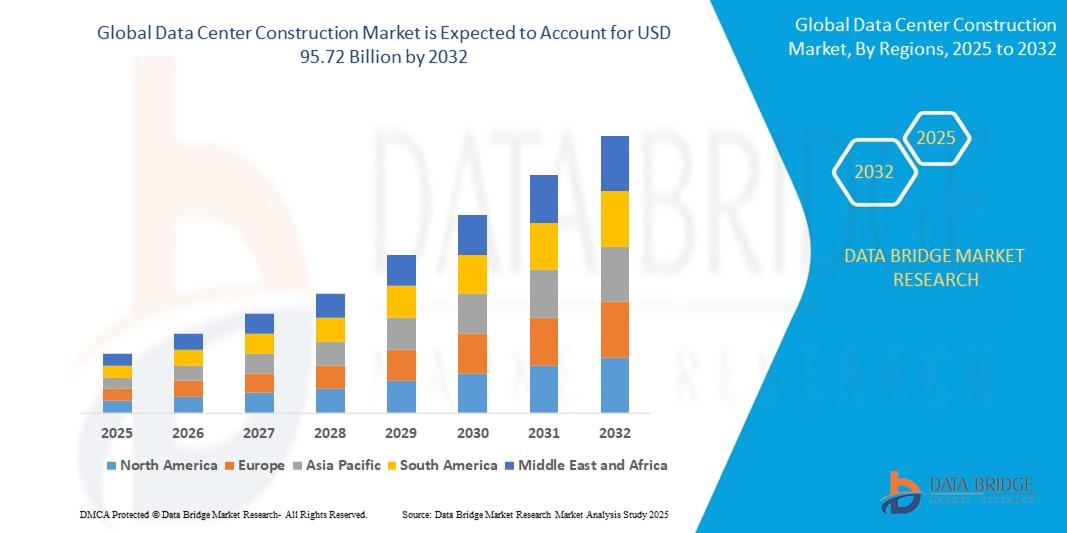
- The global data center construction market was valued at USD 48.39 million in 2024 and is expected to reach USD 95.72 billion by 2032
- During the forecast period of 2025 to 2032 the market is likely to grow at a CAGR of 8.90 % primarily driven by the increasing demand for cloud services, AI technologies, and digital transformation initiative
Forecast Growth Outlook
| Year | Expected Market Valuation (USD) |
|---|---|
| 2025 | 240–260 billion |
| 2028 | 300–330 billion |
| 2030 | 380–410 billion |
| 2033 | 520–550 billion |
| 2035 | 720–760 billion |
Growth is driven by physical infrastructure demand rather than software spending. Investors now categorize large data floors as critical infrastructure, not commercial real estate.
Key Growth Drivers
1. Power Density Expansion
-
AI GPU racks require 20–60 kW per rack.
-
New facilities are built with high-voltage layouts and redundancy-supported blueprints.
2. Global Data Explosion
-
Annual global data production rising faster than enterprise computing capacity.
-
Edge-required cluster builds increasing across telecom and content streaming firms.
3. Cloud and Colocation Growth
-
65% of global enterprises will adopt hybrid cloud solutions by 2032.
-
Colocation construction is overtaking enterprise owned DC builds.
4. 5G, IoT, and Edge Expansion
-
Smart cities, connected transportation, automated retail, remote health monitoring, and industrial IoT create ultra-low-latency compute infrastructure demand.
-
Micro data centers near consumer zones rising.
5. Sustainability Pressure
-
Governments and organizations pushing energy-efficient builds.
-
Renewable-linked DC parks increasing.
6. Government Data Sovereignty Laws
-
Mandates for regional local data hosting are increasing national construction demand.
7. Digital Economy Investments
-
Countries investing in national DC ecosystems to attract cloud providers and AI research firms.
Emerging Market Opportunities
Asia-Pacific & Africa
-
Rising digitalization + industrial automation integration.
-
Land and energy-linked investment incentives available.
-
Modular DC shipping pilots rising.
Middle East
-
Major interconnection corridor investments.
-
Government-funded cloud cluster buildouts.
-
Renewable energy-based DC parks.
Latin America
-
Fiber-linked construction for international connectivity hubs.
-
National data parks.
Cost Per Megawatt Trends (Estimated)
| Region | 2025 Cost per MW (USD Million) |
|---|---|
| North America | 7.1 – 8.5 |
| Europe | 6.8 – 8.2 |
| APAC | 5.2 – 7.6 |
| LATAM | 4.8 – 6.9 |
| MEA | 4.1 – 6.2 |
FAQs
-
What is the current market size of the Lithium-Ion Battery Market?
-
Which regions lead the Olive Oil Market in revenue share?
-
What are the main challenges in the Sustainable Sportswear Market?
-
How has demand shifted in the Arcade Gaming Market in recent years?
-
What storage technologies dominate the All-Flash Array Market?
-
What is driving adoption in the Hair Accessories Market?
-
How is digital payment infrastructure shaping the Digital Remittance Market?
-
Which cooling technologies are most used in Data Center Construction projects?
-
What factors influence forecast CAGR variations across markets?
-
Which policies support expansion in the Middle East Bio-Based Lubricants Market?
-
What are key end-user sectors for olive oil consumption growth?
-
How are dried fruits segmented by application in the global market?
-
What materials drive long-term sustainability in sportswear production?
-
What innovations are shaping arcade gaming hardware development?
-
What transformer and UPS constraints affect data center construction timelines?
-
What power density requirements define AI-optimized data center builds?
-
Which fruit types create the highest revenue share in the Dried Fruits Market?
-
How is carbon-efficient concrete being used in hyperscale DC construction?
-
What is immersion cooling and how is it scaling in new builds?
-
How do climate conditions influence cooling engineering costs?
- Browse More Reports:
North America Circuit Breaker and Fuses Market
Europe Biomarkers Market
Middle East and Africa Bioherbicides Market
Asia-Pacific Bio-Based Lubricants Market
Latin America Animal Feed Organic Trace Minerals Market
Global Cookie Mixes Market
Global Augmented Reality and Virtual Reality Market
Global Geographic Information System (GIS) Market
Global Spend Analytics Market
Global Fish Food Packaging Market
Global Luxury Gin Market
Global Polymerase Chain Reaction (PCR) Devices Market
Global Bluetooth Speakers Market
Global Composite Cardboard Tube Market
Global Rotomolding Products MarketAbout Data Bridge Market Research:
An absolute way to forecast what the future holds is to comprehend the trend today!
Data Bridge Market Research set forth itself as an unconventional and neoteric market research and consulting firm with an unparalleled level of resilience and integrated approaches. We are determined to unearth the best market opportunities and foster efficient information for your business to thrive in the market. Data Bridge endeavors to provide appropriate solutions to the complex business challenges and initiates an effortless decision-making process. Data Bridge is an aftermath of sheer wisdom and experience which was formulated and framed in the year 2015 in Pune.
Contact Us:
Data Bridge Market Research
US: +1 614 591 3140
UK: +44 845 154 9652
APAC : +653 1251 975
Email:- corporatesales@databridgemarketresearch.com

 English
 Arabic
 French
 Spanish
 Portuguese
 Turkish
 Dutch
Dutch
 Italiano
 Russian
 Romaian
 Portuguese (Brazil)
 Greek
Greek