


 Anket Doldur
 Bulmaca
 Hizmet Şartları
Kunliwelding Guide: ER5087 vs ER5356 Selection Tips
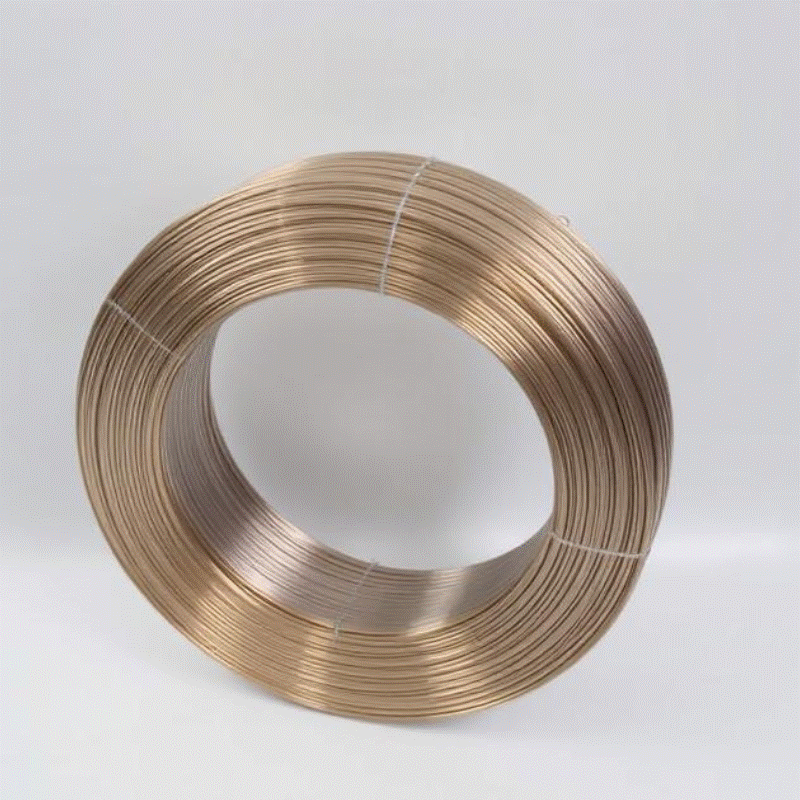
Selecting appropriate filler materials for structural Aluminum fabrication requires careful consideration of multiple factors that influence long term performance and safety. When engineers face decisions involving critical load bearing assemblies, the choice between Aluminum Welding Wire ER5087 and its close relative ER5356 becomes particularly significant. Both alloys belong to the Aluminum magnesium family, yet their distinct compositional profiles create meaningful differences in how they perform under stress, environmental exposure, and thermal cycling.
Magnesium content stands as the primary compositional difference between these two welding wires. This variation affects strength characteristics, corrosion behavior, and susceptibility to stress corrosion cracking in different ways. Higher magnesium levels generally contribute to increased tensile strength but can influence other properties that matter in critical applications. Understanding this fundamental tradeoff helps fabricators align material selection with specific structural requirements and anticipated service conditions.
Corrosion resistance patterns differ between these alloys in ways that impact their suitability for various environments. Saltwater exposure, industrial atmospheres, and chemical contact all challenge Aluminum structures differently. One composition may demonstrate better resistance to general corrosion while the other shows advantages against localized attack or intergranular penetration. The operating environment where the structure will spend its service life should heavily influence which filler material receives consideration.
Crack sensitivity during welding and in service represents another crucial selection criterion. Some Aluminum magnesium alloys show greater tendency toward hot cracking during solidification, while others exhibit vulnerability to stress corrosion cracking after fabrication. The base metal being joined, joint design, and residual stress levels all interact with filler metal properties to determine crack risk. Structures subject to sustained tensile loads in corrosive environments demand particularly careful filler selection to avoid premature failure.
Strength requirements must be balanced against ductility needs in critical structures. Aluminum Welding Wire ER5087 offers a different strength to ductility ratio compared to ER5356, creating implications for how joints respond to impact loads, fatigue cycling, and overload conditions. Structures requiring energy absorption capacity may prioritize ductility, while those facing primarily static loads might emphasize strength. The expected loading scenarios should guide this aspect of material selection.
Color matching after anodizing becomes relevant when structures will receive protective or decorative surface treatments. The slight compositional differences between these filler metals can create visible tone variations after anodizing processes. While not affecting structural integrity, aesthetic considerations sometimes influence material choices in architectural or consumer facing applications where appearance matters alongside performance.
Weldability characteristics including arc behavior, puddle control, and spatter generation vary between these alloys. One may produce smoother bead profiles with less post weld cleanup required, while the other might offer advantages in out of position welding or thin section applications. The fabrication methods and welder skill levels available in a given shop can make certain filler materials more practical than others.
Thermal expansion coefficients and their match with base metals affect residual stress development and dimensional stability in welded assemblies. Close coefficient matching minimizes distortion and stress concentration, contributing to longer service life. The specific base alloys being joined should factor into filler material decisions to optimize thermal compatibility.
Making informed choices between these welding wires requires analyzing the complete picture of structural demands, environmental factors, and fabrication constraints. Consulting material specifications and considering application specific testing helps validate selections for critical structures where failure could have serious consequences. Comprehensive technical support and material selection guidance are available at https://kunliwelding.psce.pw/8hphzd to assist with your Aluminum fabrication projects.

 English
 Arabic
 French
 Spanish
 Portuguese
 Deutsch
 Dutch
Dutch
 Italiano
 Russian
 Romaian
 Portuguese (Brazil)
 Greek
Greek